
If you ask any farmer what keeps them up at night, the answer is often small, winged, and relentless: Thrips.
They hide in the tightest buds, reproduce faster than you can scout, and by the time you see the damage, the infestation is already established. Traditional Thrips management has always been reactive : you spot the problem, then you spray. But what if you could know the problem was coming before it arrived?
At j-tec GmbH, we are changing the conversation from “How do I kill Thrips?” to “When will the Thrips arrive?” And the key to that answer lies in a scientific principle every farmer can use: Growing Degree Days (GDD).
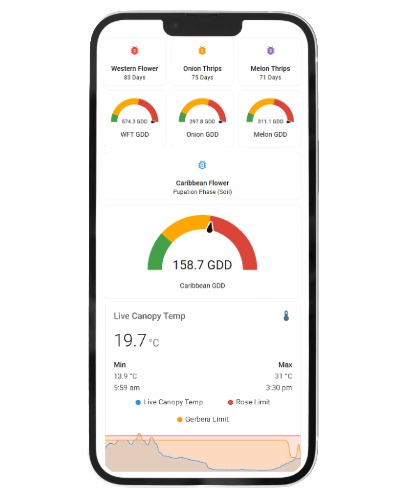
What Are Growing Degree Days (GDD)? A Simple Explanation
Insects are cold-blooded. Their body temperature and therefore their development, reproduction, and migration is entirely controlled by the surrounding air temperature.
Every insect species has a “base temperature” (the minimum heat required for development) and an “upper threshold” (the maximum heat at which development stops). Between these two points, heat accumulates. That accumulation is measured in Growing Degree Days.
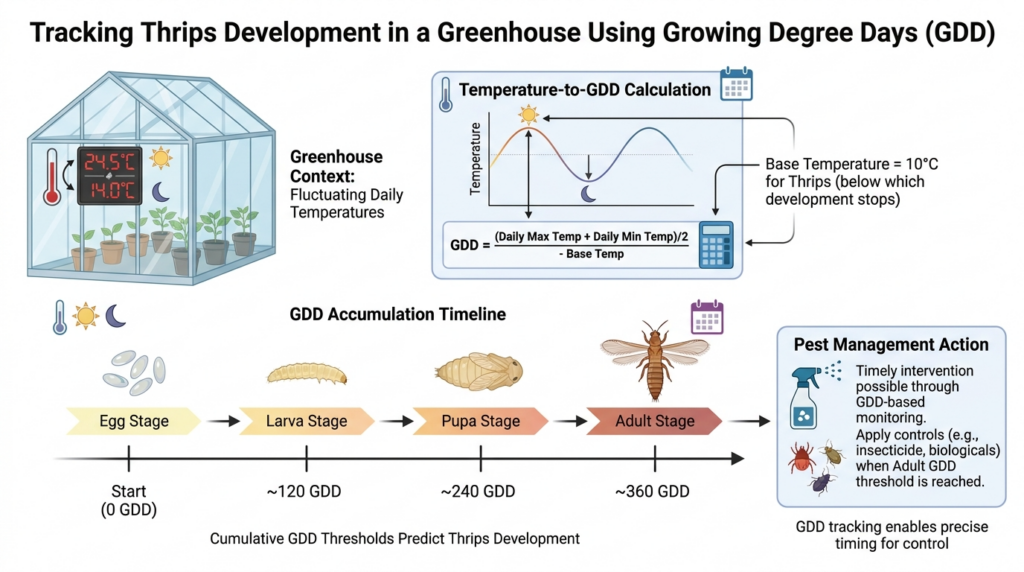
The Basic GDD Formula:
GDD = ((Daily Max Temp + Daily Min Temp) / 2) − Base Temperature
For example, if the Western Flower Thrips has a base temperature of 10°C, and today’s average temperature is 25°C, then:
GDD for today = 25 − 10 = 15 GDD
Add that up day by day, and you get a running total — a biological clock for the pest.
Why This Matters:
Every insect needs a specific number of GDD to complete each life stage, from egg, larva, pupa to adult. When you know the GDD requirements, you can predict:
- When eggs will hatch
- When larvae will feed (the most damaging stage)
- When adults will emerge and reproduce
- When the next generation will begin
This is the difference between reacting to a fire and preventing it from starting.
The Upgrade: What's New in Your j-tec Dashboard?
We have expanded our monitoring capabilities to cover multiple Thrips species simultaneously, giving you a comprehensive view of your greenhouse or field ecosystem. Our new Multi-Species Pest Monitor tracks GDD accumulation for:
Each species has its own base temperature, its own development rate, and its own GDD threshold. Our dashboard tracks them individually, because treating them as one “Thrips problem” is a mistake.
| Pest Species | Monitoring Cycle |
|---|---|
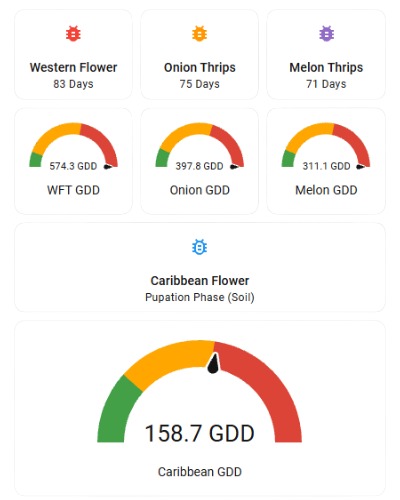
| Western Flower Thrips | 83 Days |
| Onion Thrips | 75 Days |
| Melon Thrips | 71 Days |
| Caribbean Flower Thrips | Pupation Phase (Soil) |
Visualizing the Data: The GDD Gauge
We know that data is only useful if it is easy to understand. Our dashboard features intuitive GDD gauges for each species.
Example 1: Western Flower Thrips: 574.3 GDD
The gauge shows a current accumulation of 574.3 GDD. If research tells us that Western Flower Thrips adults emerge at, say, 600 GDD, you know you are close to a critical threshold. You can prepare your treatment — whether chemical or biological — before the adults appear.
Example 2: Onion Thrips: 397.8 GDD
Onion Thrips develop faster than Western Flower Thrips. At 397.8 GDD, you may already be in the middle of a larval generation. The gauge warns you: act now, or the next generation will be harder to control.
Example 3: Melon Thrips: 311.1 GDD
Melon Thrips have a shorter cycle (71 days) and a different base temperature. At 311.1 GDD, the dashboard helps you time your intervention precisely. No wasted sprays, no missed windows.
Example 4: Caribbean Flower Thrips: 158.7 GDD (Pupation Phase)
This is where the j-tec system becomes truly sophisticated. The Caribbean Flower Thrips pupates in the soil, not on the plant. Our dashboard currently shows 158.7 GDD in the Pupation Phase.
This is critical information. It tells you:
- The pest is currently in the soil, not on the leaves.
- Spraying the foliage now would be useless.
- The correct action is a soil treatment — drenching, beneficial nematodes, or soil-applied insecticide.
- You have a precise window before adults emerge.
Without GDD data, you would be guessing. With j-tec, you know exactly where the pest is and what it is doing.
The j-tec Advantage: Sophisticated, yet Simple
We designed this tool to be “smart but straightforward.” You don’t need to be an entomologist to use it.
- Species-Specific GDD Models: We track Western Flower, Onion, Melon, and Caribbean Thrips individually — because each has its own biological clock.
- Parallel Integration: It runs seamlessly alongside your existing sensors. No need to rip and replace your current setup.
- Predictive, Not Reactive: The gauges warn you before the damage appears, giving you time to act.
- Actionable Data: When the needle hits the red zone, you know it’s time to treat — and you know what to treat.
The Result: A Healthier Crop, A Better Bottom Line
By adopting GDD modeling with j-tec GmbH, you are optimizing every input:
- Fewer sprays: You treat only when the pest is vulnerable.
- Lower costs: Less chemical, less labor, less waste.
- Higher yield: You protect your plants before the damage is done.
- Better timing: You hit the pest at its weakest point — whether that’s in the soil or on the leaf.
It is time to let the temperature do the talking. Welcome to the future of precision horticulture.
Ready to See Your GDD Data in Action?
contact our team to learn how to integrate GDD-based pest monitoring into your operation
References
Batuman, O., Campbell, A.J., Ullman, D.E., Gilbertson, R.L., McRoberts, N. and Coop, L. (2015) ‘Using a degree day insect development model to guide strategic management of western flower thrips and tomato spotted wilt virus on processing tomato in the Central Valley of California’, Acta Horticulturae, 1069, pp. 309–314. Available at: https://www.actahort.org/books/1069/1069_44.htm [citation:7][citation:3].
Edelson, J.V. and Magaro, J.J. (1988) ‘Development of onion thrips, Thrips tabaci Lindeman, as a function of temperature’, Southwestern Entomologist, 13, pp. 171–176.
Jarosik, V., Kolias, M., Lapchin, L., Rochat, J. and Dixon, A.F.G. (1997) ‘Seasonal trends in the rate of development of western flower thrips (Frankliniella occidentalis) in greenhouse cucumber’, Entomologia Experimentalis et Applicata, 84(2), pp. 147–154. Available at: https://www.semanticscholar.org/paper/Seasonal-trends-in-the-rate-of-population-increase-Jaros%CC%86%C4%B1%CC%81k-Kolias/9e5e0d6a31b2b5a2f10d3b0cb4966ddc8ea1f8bd [citation:10].
Liu, T.X. (2014) ‘Effects of temperature on the development and population growth of the melon thrips, Thrips palmi, on eggplant, Solanum melongena‘, Journal of Insect Science, 14(1), p. 78. Available at: https://doi.org/10.1093/jis/14.1.78 [citation:8][citation:19].
McDonald, J.R., Bale, J.S. and Walters, K.F.A. (1998) ‘Effect of temperature on development of the western flower thrips, Frankliniella occidentalis (Thysanoptera: Thripidae)’, European Journal of Entomology, 95(2), pp. 301–306. Available at: https://www.eje.cz/artkey/eje-199802-0014.php [citation:1][citation:9][citation:12].