
Light-Intensity sensor
The XZ-DS01-LUA is a compact, low-power LoRa wireless light intensity sensor designed for reliable remote monitoring. It integrates a high-range lux sensor (0–200,000 lx), signal processing circuit, LoRa communication module, and long-life lithium battery in a single, wall mounted unit. Featuring a wireless range of up to 5 km (line of sight) and congurable transmission intervals, it o ers accurate light measurement (±5%) with minimal maintenance. Ideal for smart agriculture, environmental monitoring, and greenhouse automation

The sun is shining
| Use | Light intensity sensor |
| Description | LUX Sensor |
| Model Number | XZ-DS01-LUA |
| Series | LoRa sensor |
| Place of Origin | China |
| Output | Digital sensor |
| Brand | LoRa Wireless Light Intensity Sensor |
| Voltage - Supply | 3.6V |
| Output Type | Digital |
| Features | LoRa wireless communication |
| Lux Range | 0–200000 lx |
| Accuracy | <±5% |
| Power Supply | ER26500 3.6V Lithium battery |
| Battery Life | 5 years @ 8700 mAH |
| Wireless Distance | 5 km (Line of Sight) |
| Transmission Interval | 30 mins default, 1–240 mins settable |
| Working Frequency | 480 / 868 / 915 / 433 MHz |
| Single Package Size | 12 × 6 × 6 cm |
| Single Gross Weight | 0.300 KG |
Lux Sensor Features and Data
-
Long Range (LoRa)
up to 3km Line of Sight. Measure where you need it-
-
Indoor, Outdoor CEA
Designed for rush outdoor conditions as well as Closed Environment Agriculture (CEA)
-
Plug n Measure
100% Compatible and Integrated with the j-tec Appliance
Photoperiod - turn night into day
Why Light Matters: Understanding Photoperiod
Plants sense day length to know when to flower, fruit, or grow. This is called the photoperiod.
The critical day length is the photoperiod that triggers flowering in photoperiod-sensitive plants, typically around a 13-hour threshold.
Therefore all plants are classified in mainly three categories:
Short-day plants (SDPs): Flower when days are short and nights long (e.g., poinsettias, rice).
Long-day plants (LDPs): Flower when days are long (e.g., spinach, lettuce).
Day-neutral plants: Flower based on maturity, not light (e.g., tomatoes, corn).
Natural photoperiod ties you to the seasons. But with artificial lighting and a lux meter, you can take control. This allows you to grow crops which may could not be cultiated in your Area as well as it allows you to controll when a plants stays in vegetative phase (growing) or flowering phase.
Controlling Flowering with Light
By adjusting light duration, you can make plants flower on your schedule.
For Long-Day Plants (e.g. lettuce in winter):
Use day-extension lighting after sunset. Low-intensity light (measured with your lux meter to ensure even coverage) tricks plants into “thinking” it’s still a long summer day, triggering flowering out of season.
For Short-Day Plants (e.g. poinsettias in summer):
Use night-interruption lighting. Turning on low-intensity light for a few hours in the middle of the night breaks the dark period, preventing flowering and keeping plants in the growth stage until you’re ready.
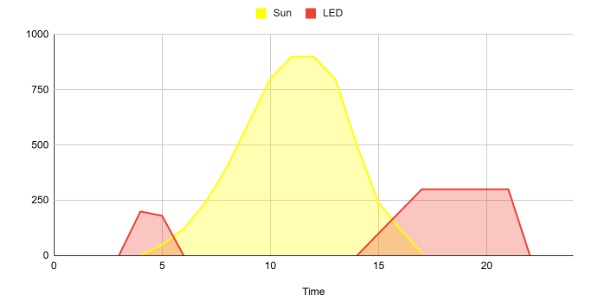
Sample: Natural-Sunlight for 12h (below critical length). Extended with artificial LED-Light in order to achieve a total day-length of 18h
Control Intensity
Plants require a certain light intensity to grow properly. Depending on the area or time of year, natural sunlight may not be bright enough.
This can lead to improper growth or side effects like elongation.
Supplemental lighting can solve this problem. Using a light intensity sensor, this process can be automated to work year-round, compensating for all weather conditions.
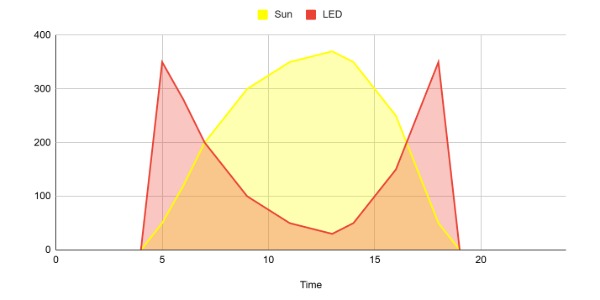
The sample shows supplemental lighting in order to achieve the same intensity all day long.