The 2-in-1 LoRa agricultural sensor offers reliable wireless monitoring of temperature and humidity, making it ideal for greenhouse and environmental applications. Featuring long range LoRa communication (up to 3KM line-of-sight), it delivers accurate data even in remote locations. With a wide detection range, durable wall-mounted design, and battery-powered operation, it ensures continuous, low-maintenance performance for optimized crop and climate management.
No HEAT Stress
Type
Wireless temperature and humidity sensor
Place of Origin
Guangdong, China
Warranty
1 year
Model Number
XZ-DSF1-TH1
Material
ABS plastic
Product Name
LoRa Wireless Temperature Humidity Sensor
Description
Greenhouse Temperature and Humidity Sensor
Measuring Range
-40°C~+80°C, 0~100%RH
Power Supply
ER26500 3.6V Lithium battery
Battery Life
5 years @ 8700mAH
Battery
Replaceable by user
Wireless Distance
Up to 5KM line of sight
Transmission Interval
5 mins default, 1~240 mins settable
Working Frequency
480 / 868 / 915 / 433 / 925 MHz
Protection Level
IP67
Single Package Size
15 × 10 × 5 cm
Single Gross Weight
0.300 KG
Features and Data
Long Range (LoRa)
up to 3km Line of Sight. Measure where you need it-
Indoor, Outdoor CEA
Designed for rush outdoor conditions as well as Closed Environment Agriculture (CEA)
Plug n Measure
100% Compatible and Integrated with the j-tec Appliance
To Hot ? to cold? to Humid?
stop gessing and start knowing!
Specific advantages of temperature and humidity sensors
Reliable temperature and humidity sensors are standard equipment in modern greenhouses and controlled environment agriculture (CEA) facilities. They provide continuous data on the internal climate and make patterns visible 24/7 also while you are not on site.
Automatic Climate Control
The measured values can be used to directly control heating, ventilation, shading and humidification or dehumidification. This brings the climate back into the target zone. Thus reduces plant stress and often results in higher and more uniform yields over time. More Information on: ResearchGate ,open-access papers published by MDPI.
Energy Optimisation
Every unnecessary temperature peak or excessive dehumidification costs energy. In practice, this leads to lower heating and cooling demand without compromising crop performance. Many research projects focus on optimising the balance between climate control and energy use.
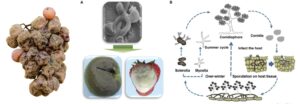
High relative humidity (often above 80–90 %) together with condensation on leaves strongly favours fungal diseases such as Botrytis (grey mould) and various powdery or downy mildews. Well placed temperature and humidity sensors help to detect these critical humidity phases early on. They often occur during late evening or during the night when no person is on site.
What can be calculated from temperature and humidity?
Vapor Pressure Deficit (VPD)
In practice, VPD is the most important derived parameter from temperature and RH.
Definition: Difference between the saturation vapour pressure of the air at the current temperature and the actual vapour pressure at a given air humidity.
Meaning of VPD:
Shows how ‘thirsty’ the air is: drives transpiration.
VPD too low: air ‘full’ of water, low transpiration, high risk of disease.
VPD too high: plants close stomata, stress, growth inhibitors
Practical benefits:
Run target VPD instead of just target temperature
Store target VPD ranges by crop + development stage
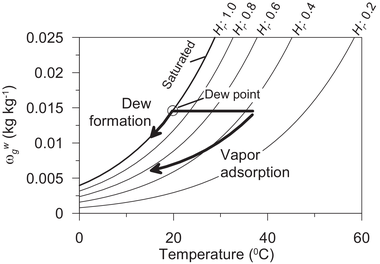
Dew point & condensation risk
Oxford definition of dew-point: The atmospheric temperature (varying according to pressure and humidity) below which water droplets begin to condense and dew can form.
The Dew-point can be calculated from temperature + RH (Relative Humidity).
When the surface temperature (leaf) falls below the dew point, condensation occurs which can lead to fungal deceases (botrytis, mildew, etc.).
Practical use:
Dew point alarm at night when RH is close to 100%.
Control strategies such as: briefly heat up + ventilate before the dew point is reached.