
Powdery Mildew:
The Warm-Weather Deceiver
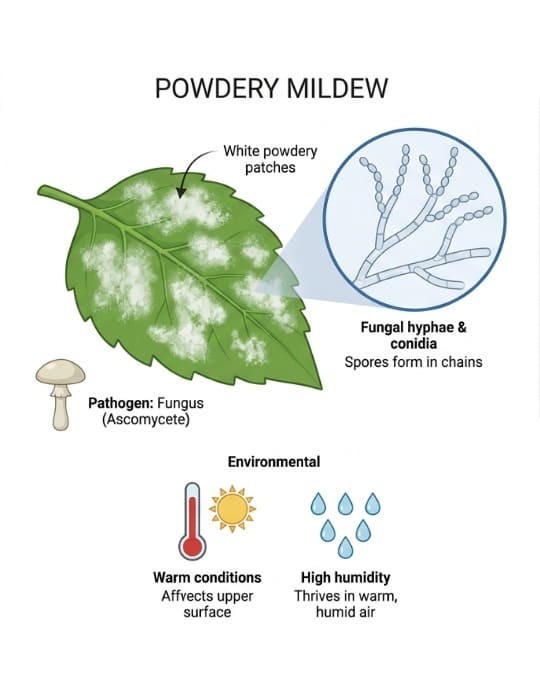
Powdery mildew (Erysiphe spp., Podosphaera spp.) announces itself unmistakably: a white, flour-like coating spreads across leaf surfaces, stems, and sometimes flowers. Despite its dramatic appearance, many growers underestimate it in the early stages. This is a mistake that can cost an entire crop.
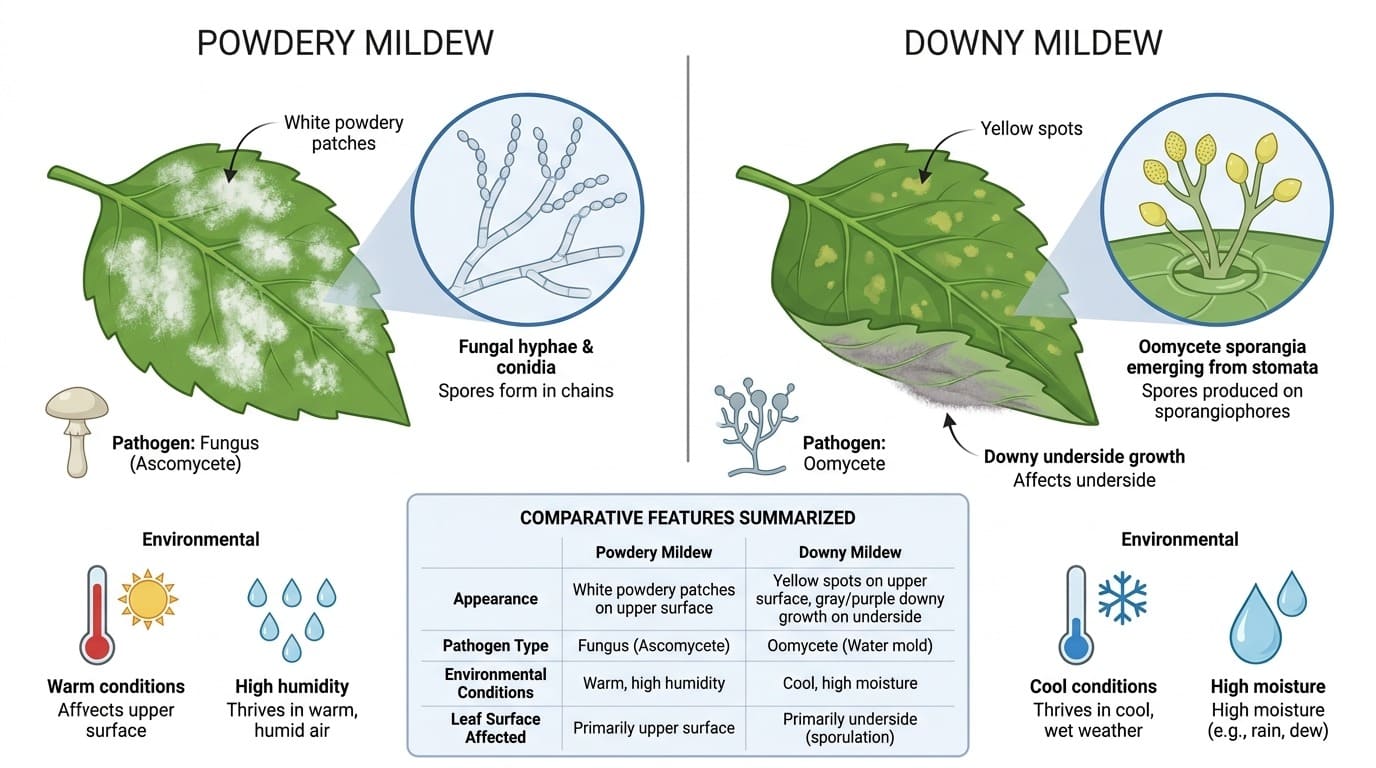
What makes powdery mildew unusual among fungal pathogens is that it thrives in warm, relatively dry conditions. The optimal temperature range sits between 18–28°C, with moderate humidity of around 50–70% RH. Free water on the leaf surface actually inhibits germination. This means irrigation or rain can temporarily suppress it, while dry, warm greenhouse conditions accelerate it.
Damage profile: Powdery mildew colonises the epidermal cells of leaves, drawing nutrients directly from the plant. Infected tissue loses photosynthetic capacity, leaves curl and yellow, and heavily affected plants show stunted growth and reduced fruit or flower quality. In soft fruit and ornamental crops, the economic damage can be severe within days of visible onset.
Downy Mildew:
The Night-Time Infiltrator
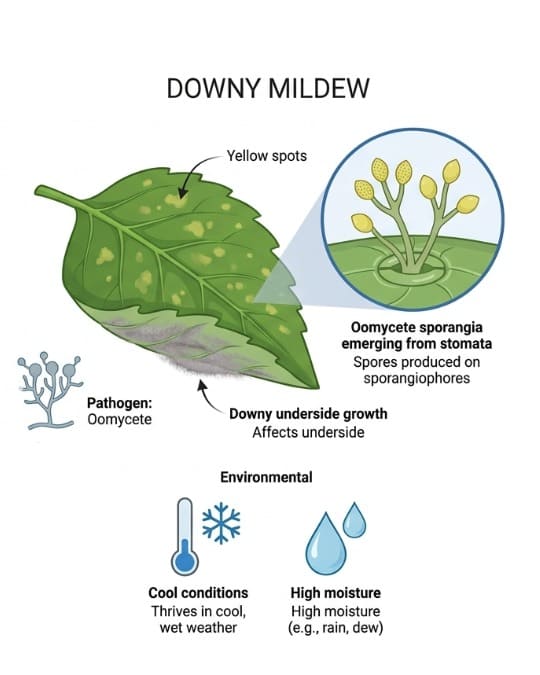
Downy mildew (Peronospora spp., Bremia spp., Plasmopara spp.) is not technically a fungus — it is an oomycete, or water mould, and its behaviour reflects that origin entirely. Where powdery mildew favours dry warmth, downy mildew is a creature of cool, wet nights.
The disease presents first as pale yellow or olive patches on the upper surface of leaves, with a characteristic grey-purple fuzzy sporulation on the undersides. Infection requires leaf wetness, condensation and high humidity above 85% RH, and temperatures between 12–18°C create the ideal window. This makes early mornings and the hours between dusk and dawn the critical infection period, often invisible to growers who inspect crops during the day.
Damage profile: Downy mildew spreads rapidly through entire rows once established, as spores released from infected undersides are carried by air movement to neighbouring plants. Tissue collapse follows quickly, and in crops like lettuce, basil, grape, and cucumber, a single night of ideal conditions can initiate an outbreak that becomes visible — and largely uncontrollable — within 48 to 72 hours.
How J-Tec Monitoring Helps Growers Stay Ahead
The challenge with both mildew variants is that by the time visual symptoms appear, the infection cycle is already well underway. Reactive treatment is expensive, often partially effective, and stressful. Monitoring changes this dynamic entirely, shifting the grower from response to prevention.
The J-Tec system uses LoRa-connected sensors to deliver continuous climate data across the growing environment. No internet cables, no complicated wiring. Sensors communicate wirelessly and feed data to the analytics platform in real time.
Powdery Mildew Risk: Temperature & Humidity Sensors
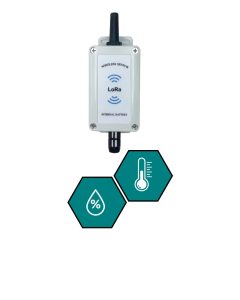
The 2-in-1 Temperature/Humidity sensors track when conditions enter the 18–28°C / 50–70% RH risk window. Rather than a single daily reading, the platform accumulates hours spent within this zone. A sustained 12-hour period at 24°C and 65% RH carries far more risk than a brief spike. Growers receive alerts before conditions reach the critical threshold, giving time to adjust ventilation or shading.
Downy Mildew Risk: CO₂, Pressure & Dew Point Tracking
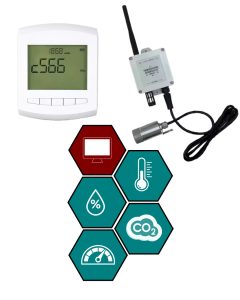
The 4-in-1 CO₂/Temperature/Humidity/Pressure sensor is particularly powerful here. The platform monitors dew point margin when air temperature approaches dew point, condensation on leaf surfaces becomes likely. Barometric pressure trends give advance warning of incoming humid weather. A grower alerted at 22:00 that dew point conditions are approaching has time to run heating pipes or open vents before the infection window opens.
Spatial Awareness Across the Growing Environment
Multiple sensor nodes placed across a greenhouse or field reveal the cold corners, low-airflow zones, and shaded rows where mildew establishes first. A single sensor gives an average; a network gives a map. Growers can target preventative measures precisely where they are needed.
Light Levels & Extended Leaf Wetness
The Lux sensor adds a further layer: low-light periods reduce plant transpiration, which slows canopy drying and extends effective leaf wetness duration. A cloudy week is a downy mildew risk week, and the platform reflects this in its risk scoring.
Mildew in horticulture does not announce itself conveniently. It works in the dark, in the humidity, in the margins of temperature that sensors miss if they only measure once an hour. The J-Tec platform was built for exactly this environment — continuous, granular, actionable data that puts the grower one step ahead of the pathogen rather than one step behind.
Mildew Prevention
- Realtime Notification
- Automation: Control Ventilation, Heating automatically
- Long-term data storage for detailed analytics
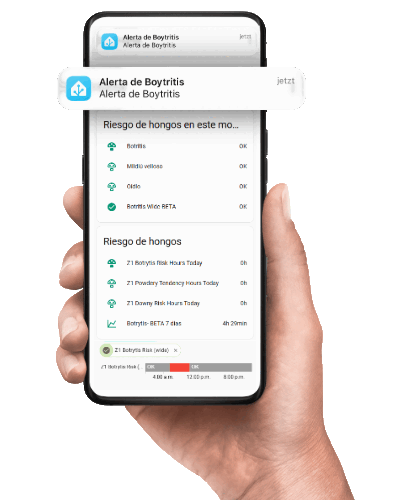
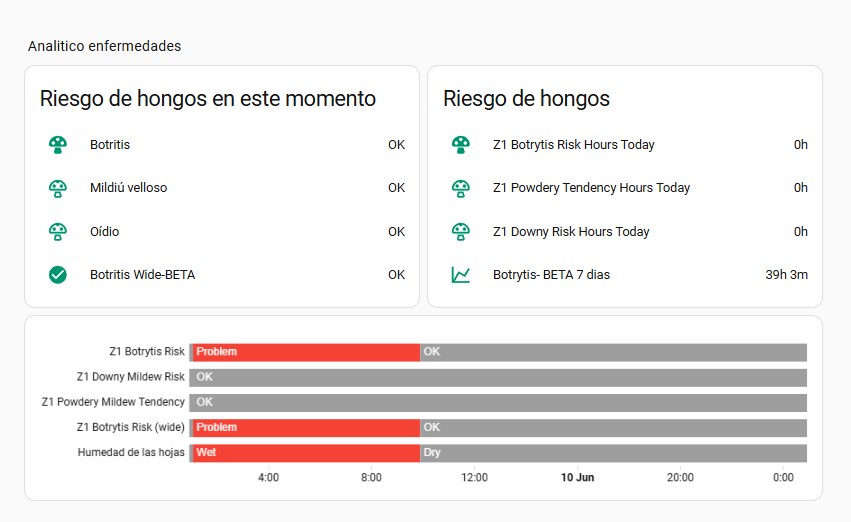
Fungal Detection
- Scientifc proven Methods
- Problem right now - Accumulated time
- Long-term data storage for detailed analytics
Botrytis in Greenhouses: How Sensor Monitoring Prevents Grey Mold
The Grey Mold Crisis Quietly Draining Mexican Greenhouses Mexico’s protected...
Leer másBotrytis Reduction- The Importance of Environmental Monitoring in
Introduction about Botrytis reduction Botrytis cinerea, commonly known as gray mold,...
Leer másReferences
- Agrios, G.N. (2005) Plant Pathology. 5th edn. Academic Press. Available via:
ScienceDirect — Powdery Mildew Overview
[Accessed June 2026]. - Agrios, G.N. (2005) Plant Pathology. 5th edn. Academic Press. Available via:
ScienceDirect — Downy Mildew Overview
[Accessed June 2026]. - Michelmore, R. et al. (2022) ‘Downy mildews: Symptoms, causes and control’, Royal Horticultural Society. Available at:
https://www.rhs.org.uk/disease/downy-mildews
[Accessed June 2026]. - Penn State Extension (2019) Addressing Downy Mildew and Powdery Mildew in the Home Garden. Pennsylvania State University. Available at:
https://extension.psu.edu/addressing-downy-mildew-and-powdery-mildew-in-the-home-garden
[Accessed June 2026]. - UC Nursery and Floriculture Alliance (2025) Understanding Powdery Mildew in Nurseries and Floriculture. University of California. Available at:
https://ucnfa.ucdavis.edu/news/understanding-powdery-mildew-nurseries-and-floriculture
[Accessed June 2026]. - UConn Integrated Pest Management (2019) Downy Mildew on Ornamentals. University of Connecticut. Available at:
https://ipm.cahnr.uconn.edu/wp-content/uploads/sites/3216/2022/12/2019downymildewonornamentalsfinal2.pdf
[Accessed June 2026]. - Horticulture Australia (2011) Powdery Mildew. Hort Innovation. Available at:
https://www.horticulture.com.au/globalassets/hort-innovation/resource-assets/ny11001-powdery-mildew.pdf
[Accessed June 2026]. - Wyenandt, C.A. et al. (2007) ‘Effect of leaf wetness duration and temperature on infection of downy mildew (Peronospora sp.) of basil’, ResearchGate. Available at:
ResearchGate — Basil Downy Mildew Study
[Accessed June 2026]. - Tognetti, R. et al. (2018) ‘Effect of climate change on infection of grapevine by downy and powdery mildew under controlled environment’, ResearchGate. Available at:
ResearchGate — Climate Change and Mildew in Grapevine
[Accessed June 2026]. - Ghimire, S.R. et al. (2022) ‘Joint communication and sensing: A proof of concept and datasets for greenhouse monitoring using LoRaWAN’, MDPI Sensors / PubMed Central. Available at:
https://pmc.ncbi.nlm.nih.gov/articles/PMC8963007/
[Accessed June 2026]. - Piotto, V. et al. (2022) ‘Autonomous IoT monitoring matching spectral artificial light manipulation for horticulture’, MDPI Sensors / PubMed Central. Available at:
https://www.ncbi.nlm.nih.gov/pmc/articles/PMC9185431/
[Accessed June 2026].