
The Grey Mold Crisis Quietly Draining Mexican Greenhouses
Mexico’s protected horticulture sector is a powerhouse: over 47,000 hectares of greenhouse and tunnel production generating $18.8 billion in horticultural exports in 2023. 93% of it is destined for the United States. Tomatoes, strawberries, peppers, raspberries, and cucumbers are exported year-round from Sinaloa, Sonora, Baja California, and the Bajío. It is one of the great agricultural success stories of the 21st century. And Botrytis cinerea is threatening to quietly destry production. Grey mold is ranked the second most economically destructive plant pathogen on earth, responsible for annual global losses estimated between $10 billion and $100 billion. Under outbreak conditions, it can destroy more than 50% of a strawberry harvest. In wet seasons, unmanaged infections have wiped out over 80% of flowers and fruit before a single picker sets foot in the greenhouse. Fungicide programs to control it typically consume nearly 15% of total strawberry production costs per year, whether or not the disease actually strikes. For Mexican growers supplying export markets with zero tolerance for visual defects, meaning a single grey lesion on a berry or tomato is not a quality issue. It is a rejected shipment. Yet this same controlled-environment agriculture – the sealed tunnels and glass houses that deliver premium yields and extended seasons – creates precisely the microclimatic conditions that Botrytis thrives in: moderate temperatures, high relative humidity, poor air circulation, and the constant presence of senescent plant tissue. The pathogen attacks strawberries in Baja California, tomatoes in Sonora, roses in the State of Mexico, and peppers across the Bajío with equal efficiency.

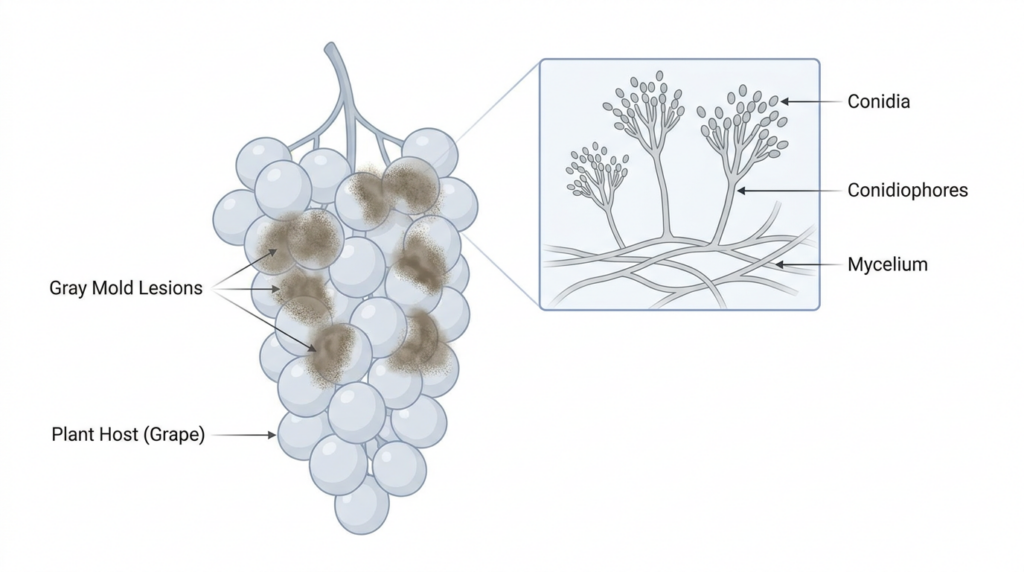
Why Botrytis Is So Difficult to Control
Botrytis cinerea is a necrotrophic fungus, meaning it feeds on dying or stressed plant tissue before aggressively colonising healthy cells. Its spores are omnipresent in the environment and can lie dormant for extended periods, waiting for the right combination of conditions to germinate and spread.
The critical environmental window is well-documented:
- Temperature: 15–25°C (optimal around 18–22°C)
- Relative Humidity: above 85%, particularly when combined with prolonged leaf wetness
- CO₂ imbalance: poor ventilation that allows CO₂ to rise and air movement to stagnate
- Light deficiency: dense canopies with low lux levels create shadowed, moisture-retaining micro-environments
The challenge for Mexican growers is that many production cycles, particularly for winter berries and tomatoes destined for North American markets run during the cooler, more humid months when these conditions naturally occur. A greenhouse that is perfectly sealed against cold nights becomes a Botrytis incubator by dawn if humidity is not actively managed.
For export-grade product, where quality thresholds are strict, even superficial grey mold on fruit surfaces causes rejection of entire shipments and with Mexico supplying 1.82 million metric tons of tomatoes worth $2.7 billion to the US in 2023 alone, the margin for error is essentially zero.
The Monitoring Gap: Why Scouting Alone Is Not Enough
Traditional pest and disease management in Mexican greenhouses relies heavily on visual identification. Trained workers walking rows and identifying problems by eye. This approach has a fundamental flaw: by the time Botrytis is visible, it has already been sporulating for 24 to 72 hours. Every grey lesion visible to the human eye represents hundreds of thousands of spores already dispersed into the greenhouse atmosphere.
Reactive fungicide applications at this stage are costly, often partially effective, and contribute to the growing problem of fungicide resistance. This is a documented concern across Mexican strawberry and tomato production zones.
What growers need is intelligence ahead of the outbreak, not documentation of one already underway.
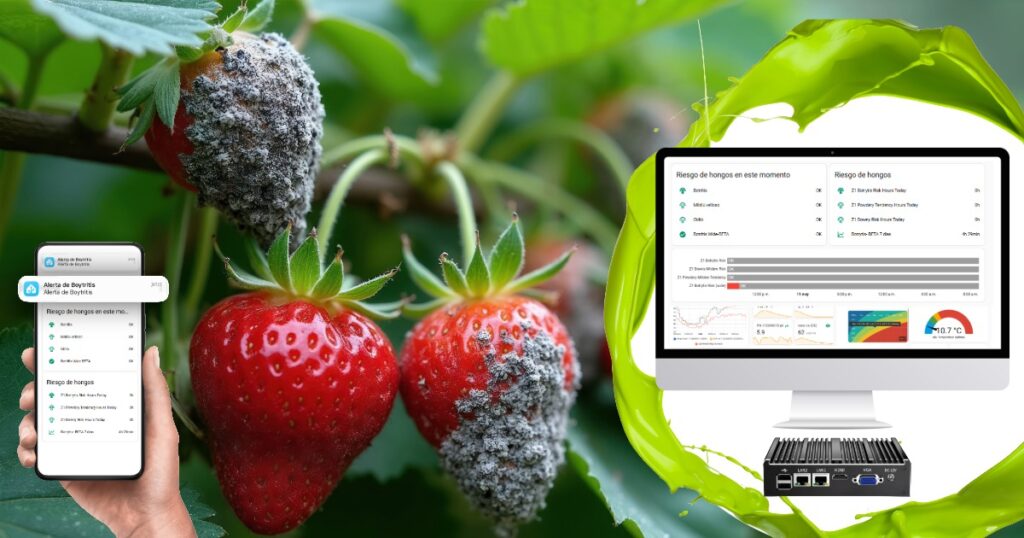
How J-Tec's LoRa Sensor Network Changes the Equation
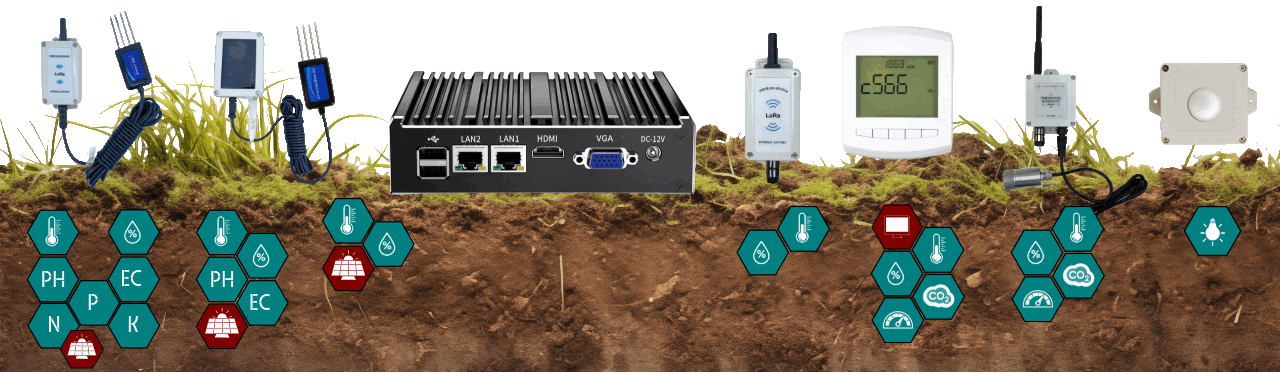
J-Tec’s Monitoring and Analytic Solutions for Horticulture deploy a network of wireless LoRa sensors throughout the greenhouse structure, capturing real-time environmental data at canopy level – precisely where disease risk originates.
The sensor portfolio covers every critical parameter:
- 2-in-1: Temperature & Humidity Sensors placed at multiple canopy heights detect the humidity gradients and overnight condensation events that precede Botrytis germination.
- 4-in-1: CO₂, Temperature, Humidity & Pressure Sensors identify stagnant, poorly ventilated zones where pathogen pressure accumulates undetected.
- Lux Sensors flag low-light micro-zones within dense canopies which are natural hotspots for moisture retention and fungal development.
- Soil Sensors (2-in-1 and 4-in-1) monitoring temperature, moisture, pH, and EC ensure that irrigation practices do not inadvertently raise atmospheric humidity through excessive evapotranspiration.
The true power lies in the analytics layer. J-Tec’s platform continuously evaluates incoming sensor data against known Botrytis risk models, issuing alerts when temperature-humidity combinations enter the danger zone — before spore germination occurs. Growers receive actionable warnings with enough lead time to intervene: adjusting ventilation, modifying irrigation scheduling, or applying preventive treatments at the optimal biological window.
From Data to Decision: A New Standard for Mexican Growers
For a Mexican strawberry producer managing 10 hectares of tunnels in Baja California, the difference between a J-Tec alert at 3:00 AM and discovering grey mold at 8:00 AM during scouting is the difference between a ventilation adjustment and a lost export shipment.
Smart environmental monitoring does not replace agronomic expertise, it amplifies it. When growers understand exactly what their crops are experiencing hour by hour, they make better decisions on ventilation timing, heating strategy, canopy management, and chemical application. The result is fewer treatments, lower input costs, higher marketable yields, and produce that meets the increasingly rigorous phytosanitary standards demanded by export markets.
Botrytis will always be present in the Mexican greenhouse environment. With J-Tec’s sensor networks and predictive analytics, it no longer has to be inevitable.

Sieh dir diesen Beitrag auf Instagram anEin Beitrag geteilt von j-tec horticulture (@jtec_horticulture)