
j-tec’s disease monitoring system applies tried-and-tested phytopathological forecasting models directly to the ornamental plant and horticultural sectors. By combining wireless LoRa sensors, Garratt’s law of the atmospheric boundary layer and established algorithms by Broome et al., Gubler-Thomas and Goidanich, the system calculates the risk of infection by Botrytis, as well as powdery mildew and downy mildew, at the leaf surface level.
Botrytis and powdery mildew early warning system for greenhouses: stopping fungal diseases in crop production at an early stage
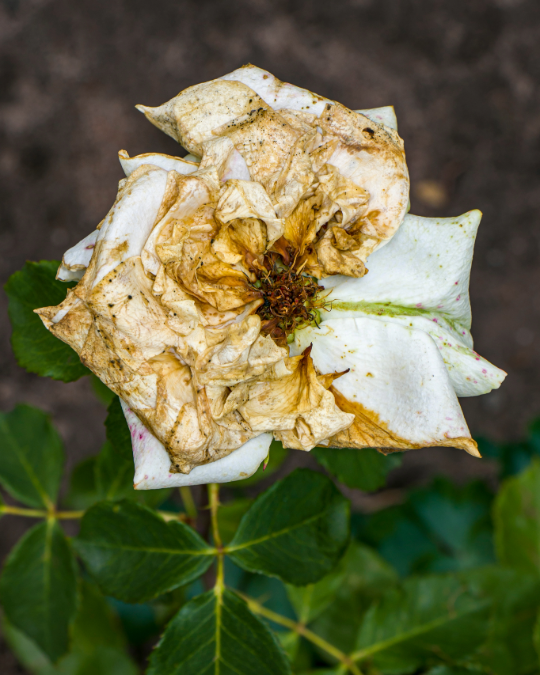
Fungal diseases are among the greatest economic risks in modern plant production, such as ornamental plant cultivation and horticulture. Particularly in closed and semi-closed greenhouses, pathogens such as Botrytis cinerea (grey mould), powdery mildew and downy mildew can spread explosively within a matter of hours. By the time the first signs of discolouration, coatings or rot on leaves and flowers become visible to the naked eye, it is often already too late for a gentle treatment. j-tec’s Botrytis and mildew early warning system closes this gap. By combining high-precision LoRa sensors with globally recognised phytopathological forecasting models, our software detects critical infection conditions directly within the crop stand, even before the visible onset of disease.
Why simple climate measurements in a greenhouse are not enough
Many growers still control their greenhouse climate using individual sensors suspended freely in the air. However, fungal spores do not germinate in the air itself, but directly on the leaf surface. Evaporation and night-time heat loss create a distinct, more humid microclimate immediately around the leaf.
To accurately model this phenomenon, the j-tec system incorporates Garratt’s law of the atmospheric boundary layer. Using this physical principle, our algorithms calculate the actual conditions within the boundary layer – which is just a few millimetres thick – on the leaf, based on the measured air temperature and humidity values. Together with continuous monitoring of the vapour pressure deficit (VPD) and the dew point, the system immediately detects when there is a risk of condensation forming on sensitive cut flowers or plants

Simple dashboard view
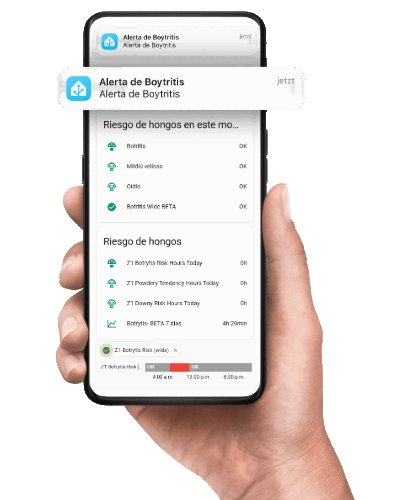
Our dashboard not only shows you whether there is currently a problem; it also keeps a record of past incidents. After all, what really matters is how long the conditions have been problematic.
Our scientific calculation models in detail
- Leaf microclimate according to Garratt’s law of the atmospheric boundary layer. Instead of relying on imprecise climate values, j-tec models the boundary layer directly at the leaf surface. This captures temperature and humidity gradients where fungal spores actually germinate.
- Botrytis infection model according to Broome et al. (1995). Based on the recognized study (Broome, English, Marois, Latorre & Aviles, Phytopathology 85:97–102), our software calculates the gray mold risk from the interaction of temperature and leaf wetness duration. This is essential for protecting sensitive flowers and cuttings.
- Powdery mildew according to the Gubler-Thomas Risk Index (UC Davis). This index, developed at the University of California (Davis) and refined in 2013, continuously assesses the temperature conditions for spore germination and reproduction of powdery mildew, for example on roses or gerbera.
- Downy mildew according to the Goidanich incubation model (1957/1964). This classic model, which also underlies modern warning services such as VitiMeteo in Austrian viticulture, calculates the exact incubation period until the outbreak of downy mildew based on temperature, humidity, and precipitation or wetting.
Frequently asked questions about the Botrytis and powdery mildew forecast model
The model developed by Broome et al. (1995) is one of the most thoroughly validated algorithms worldwide for predicting Botrytis cinerea. As it accurately assesses the critical combination of temperature and duration of wet conditions, it is ideally suited for use with sensitive greenhouse crops such as cut roses, cyclamen and poinsettias.
Whilst services such as VitiMeteo rely on the Goidanich model for regional outdoor weather stations, j-tec brings these scientific algorithms directly into enclosed or semi-enclosed greenhouses. Furthermore, via Home Assistant, automatic countermeasures such as ventilation or heating pulses can be triggered immediately should the risk increase.
From smartphone alarms to fully automatic climate control
- Instant warning on your smartphone (pure monitoring): You do not need to modify your existing technology. As soon as one of the scientific models calculates an increased infection risk, you and your team receive a real-time notification directly via app on your smartphone. This allows you to ventilate or heat in a targeted manner, or to schedule preventive treatment in good time.
- Optional full automation via Home Assistant: For businesses that want to go one step further, seamless integration into the open-source Home Assistant platform offers maximum automation. When danger threatens, the system independently activates circulation fans, selectively opens ventilation flaps, or provides a brief heating impulse to raise the dew point and dry out the crops. Through this predictive control, fungicide applications can be reduced by up to ~48%, unnecessary heating energy can be saved, and the flower quality of your crops can be sustainably secured.
We would be happy to advise you in person on sensor placement, range and the most suitable forecasting models for your business.