
Heat Stress Degree Days
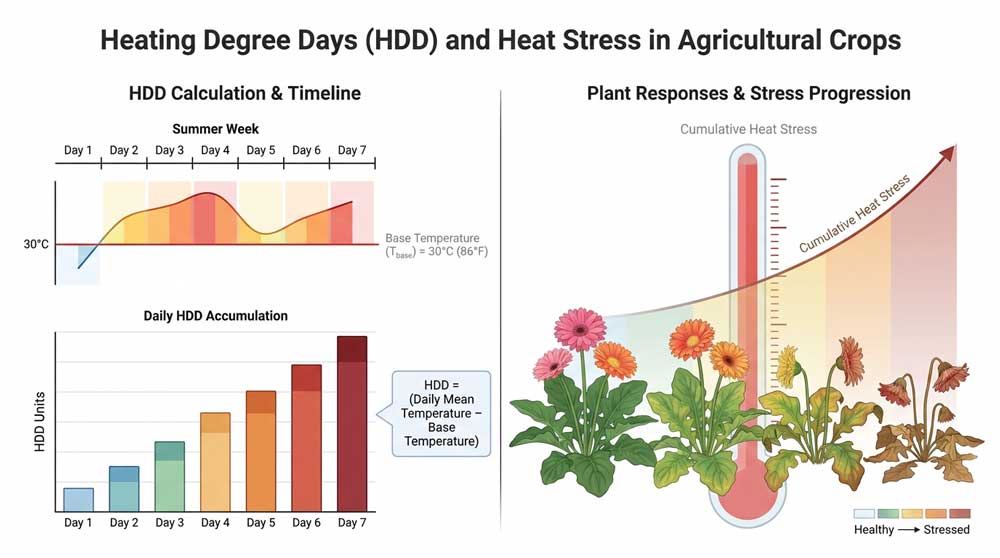
Summers are getting hotter, dry spells and drought periods are lasting longer. For farmers and greenhouse operators, this is not just a perceived problem, it endangers yields and the health of your plants. But there is a precise, data-driven way to understand and actively manage heat and dry conditions: Heating “Stress” Degree Days (HDD/HSDD) and the related concept of Growing Degree Days (GDD).
But what exactly is behind these terms, and how can they help you in your daily work? This article explains the method and shows how it becomes a success strategy in agriculture and in the greenhouse.
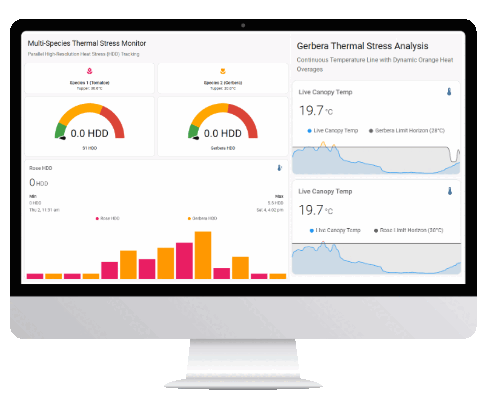
Why Are Heat Stress Degree Days So Important?
1. Detect Heat and Dry Stress Early
A major advantage of the HSDD method is objectification. Instead of relying on subjective impressions, the measurement data delivers clear numbers. This is especially valuable because plants can suffer from heat and dry stress even at supposedly moderate temperatures over extended periods. The cumulative values show when a critical threshold has been reached.
2. Better Irrigation Decisions – No More Dry Spells
During dry periods, every drop of water is precious. HSDD data helps to more precisely assess the actual water requirements of your plants. Because under heat and dry stress, plants transpire more water and the irrigation demand increases. With HSDD values, you can irrigate more precisely and efficiently. More on irrigation and water conservation!
3. Optimize Harvest Dates and Variety Selection
Evaluating HSDD over several seasons provides insight into the heat and dry stress risk at your location. You can better assess whether a particular variety is suitable for your climate or whether earlier sowing dates help to avoid the critical heat and dry phase.
4. Predict Yield Losses
Purdue University has established an interesting benchmark for corn: If the accumulated SDD sum exceeds, for example, 140, it becomes difficult to achieve an above-average yield. Such threshold values can be developed for many crops – providing a valuable planning foundation.
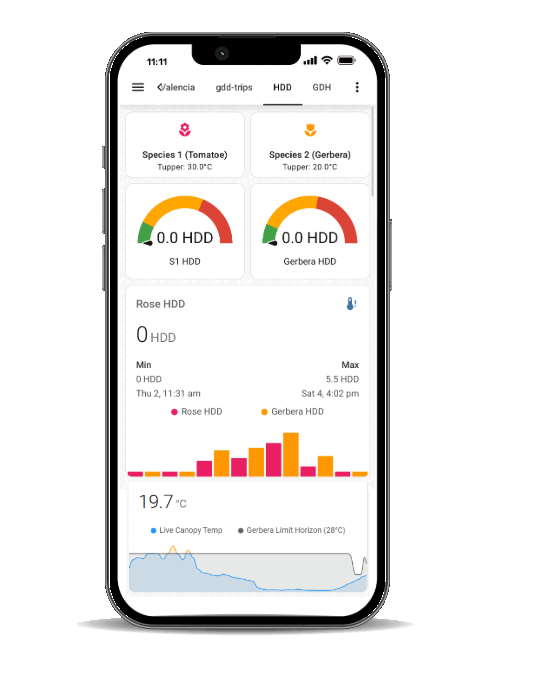
Keep an eye on the current situation always and everywhere.
Thanks to our solution, you not only have permanent monitoring of heat stress. You can also directly control your cooling, ventilation, or irrigation to actively counteract it.
- Real-time notifications for heat stress
- Automation of irrigation / ventilation
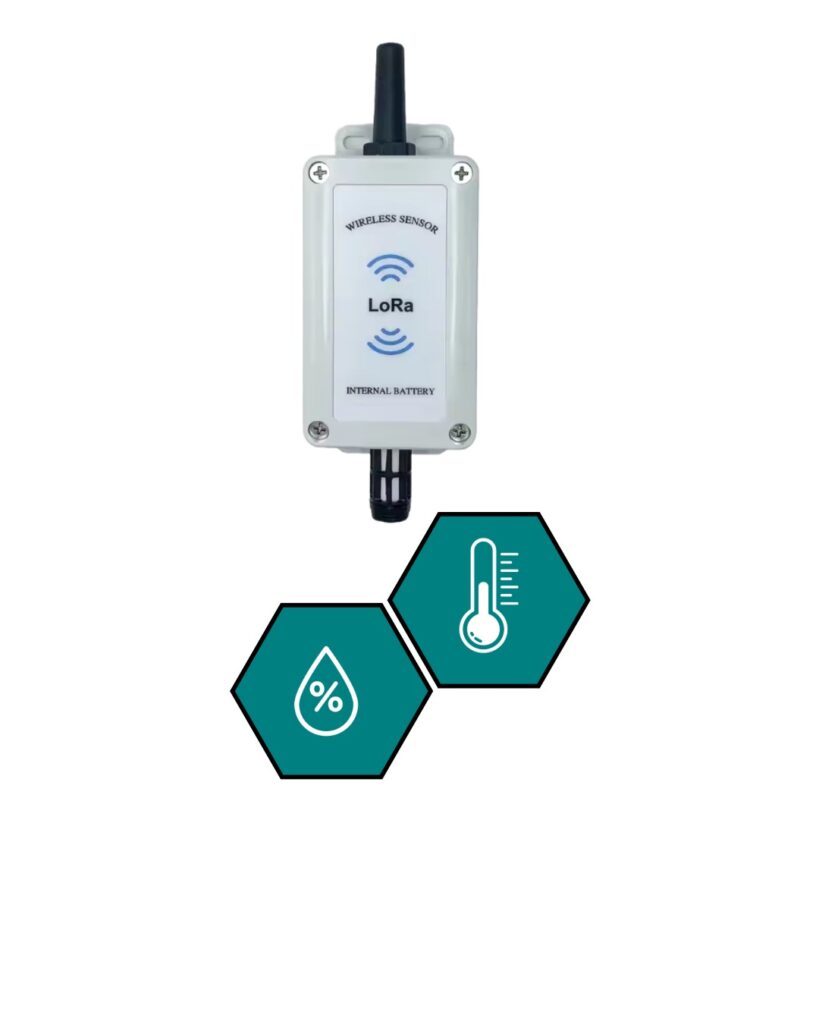
- Data-based analysis from a combination of local sensors and weather data
Conclusion: Heat Stress Degree Days – Your Early Warning System Against Heat and Dry Stress
In times of climate change, heat and dry stress are among the greatest challenges for agriculture. The Heat Stress Degree Days method provides you with a clear, objective metric to understand and manage this risk.
-
Early warning instead of reacting to acute damage
-
Precise irrigation instead of watering on suspicion
-
Better planning of variety selection and harvest dates
Whether in the field or in the greenhouse – HSDD are an indispensable tool for a future-proof, resilient agriculture.
Sources about Heat Stress Degree Days
- Jeffrey, C., Ziems, L., Kaiser, B. & Trethowan, R. (2025)
‘A growing degree day model determines the effect of temperature stress on diverse chickpea genotypes’,
Frontiers in Plant Science, 15.
doi:10.3389/fpls.2024.1496629.Relevanz: Diese Studie zeigt, dass Stress Degree Days (SDD) – eine Erweiterung des Growing Degree Day-Modells – signifikant mit Ertragsverlusten und einer Verringerung der Samengröße bei Kichererbsen korrelieren. - Zhang, F., Guo, E., Liu, Z., Zhou, L., Batchelor, W.D., Li, S. & Yang, X. (2025)
‘Evaluation of high temperature effects on maize in Xinjiang province using the DSSAT-CERES-Maize model’,
European Journal of Agronomy, 172.Relevanz: Die Forscher quantifizierten die Auswirkungen von Hitzestress auf Mais und fanden heraus, dass der Maisertrag für jeden 1 °C·d Anstieg der Hitzegradtage (Heating Degree Days) während kritischer Phasen um 0,6 % bzw. 0,3 % sinkt. - Purdue University, Midwestern Regional Climate Center (MRCC) (o.J.)
About the MRCC Modified Stress Degree Day Product.
Verfügbar unter:
https://www.mrcc.purdue.edu/index.php/VIP/aboutSDD
(Zugriff: August 2026).Relevanz: Hier wird die vereinfachte Berechnung von SDD erläutert: Differenz zwischen der täglichen Höchsttemperatur und der optimalen Temperatur für die Pflanze (z.B. 86°F für Mais). Zudem wird der praktische Richtwert genannt, dass es bei einer SDD-Summe über 140 schwierig wird, einen überdurchschnittlichen Maisertrag zu erzielen. - Purdue University, Midwestern Regional Climate Center (MRCC) (o.J.)
Modified Stress Degree Days for Corn.
Verfügbar unter:
https://mrcc.purdue.edu/index.php/VIP/indexSDD
(Zugriff: August 2026).Relevanz: Diese Seite bietet einen weiteren Überblick über die Anwendung von Stress Degree Days zur Verfolgung von Hitzestress bei Pflanzen während der Vegetationsperiode.
Further readings:
- McMaster, G.S. & Wilhelm, W.W. (1997)
‘Growing degree-days: one equation, two interpretations’,
Agricultural and Forest Meteorology, 87(4), S. 291–300.
doi:10.1016/S0168-1923(97)00027-0.Relevanz: Grundlagenwerk zur Berechnung und Interpretation von Gradtag-Modellen in der Landwirtschaft. - Ritchie, J.T. & Nesmith, D.S. (1991)
‘Temperature and crop development’, in: Hanks, J. & Ritchie, J.T. (Hrsg.)
Modeling Plant and Soil Systems.
Madison: American Society of Agronomy, S. 5–29.Relevanz: Klassische Einführung in die temperaturbasierte Modellierung von Pflanzenentwicklung und Stressreaktionen.