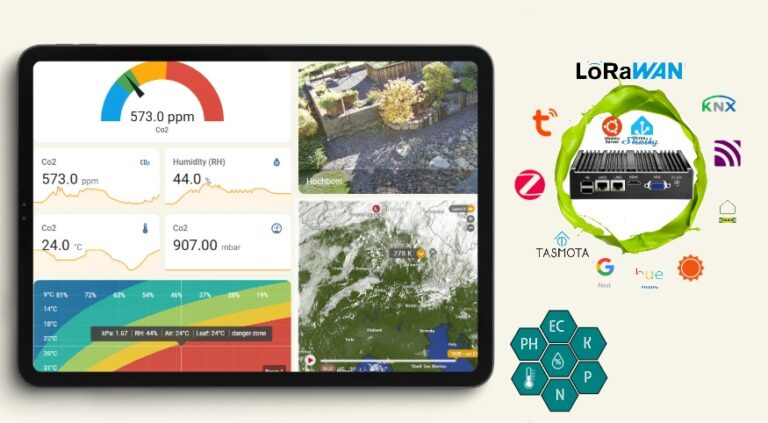
Greenhouse cultivation often still rely on intuition or simple thermostats to manage their crops. Temperature and humidity are the two most critical variables inside any greenhouse, dictating everything from photosynthetic efficiency to disease outbreak. Without continuous, long-term monitoring, growers are flying blind.
While outdoor weather stations provide regional context, the conditions inside a greenhouse can shift dramatically within minutes. Sun breaking through clouds, ventilation kicking on, or irrigation cycles starting. Long-term monitoring of temperature and relative humidity (RH) reveals the true microclimate your plants experience 24/7, enabling proactive management rather than reactive guesswork.

The Problem: Hidden Instability in the Controlled Environment
Most greenhouses use basic thermostats or timers for ventilation and heating. This approach creates dangerous blind spots:
- Disease Outbreaks: High humidity (above 85-90%) combined with moderate temperatures creates ideal conditions for botrytis, powdery mildew, and pythium. Without knowing how long humidity persists after sunset, fungicide applications are either too late or unnecessary.
- Physiological Stress: High heat combined with low humidity causes transpiration stress, reducing calcium uptake and leading to blossom end rot in tomatoes and tip burn in lettuce.
- Condensation Damage: When temperatures drop rapidly at night, condensation forms on plant tissue and greenhouse structures, promoting spore germination and fungal growth.
- Inefficient Environmental Control: Heating and ventilation run on fixed schedules or thresholds, wasting energy and creating temperature swings that stress plants.
Research shows that undetected microclimate fluctuations can reduce greenhouse crop quality by 15-25% and increase energy costs by 20-30% due to inefficient heating and ventilation scheduling.
The Solution: Continuous Microclimate Monitoring
Long-term monitoring of temperature and relative humidity transforms greenhouse management. By placing sensors at canopy level across multiple zones, growers can track key metrics including Vapor Pressure Deficit (VPD) A combined measure of temperature and humidity that indicates the air’s actual “thirst.” This data enables:
- Disease Prevention: By tracking the duration of high-humidity periods, growers can activate ventilation, heating, or dehumidification precisely when needed, stopping disease before it starts.
- VPD-Optimized Growth: Maintaining VPD within the ideal range (typically 0.5-1.5 kPa for most crops) keeps stomata open, maximizing photosynthesis and transpiration for faster, healthier growth.
- Energy Efficiency: Heating and ventilation activate based on actual plant needs rather than fixed timers, reducing energy consumption while improving crop conditions.
- Early Stress Detection: Temperature or humidity spikes trigger alerts before visible damage occurs, allowing immediate corrective action.
- Harvest Quality Optimization: For high-value crops like tomatoes, peppers, and cannabis, precise climate control during fruiting and flowering directly improves yield, potency, and shelf life.

Cost Savings and Quality Improvements
Growers implementing continuous greenhouse monitoring typically report:
- 20-35% reduction in fungicide use through targeted, condition-based applications.
- 15-25% energy savings by optimizing heating and ventilation run times.
- 10-20% yield increases from reduced stress and optimized photosynthesis.
- Improved crop uniformity and quality, commanding premium market prices.
- Reduced crop losses from undetected disease outbreaks or equipment failures.
Beyond immediate inputs, long-term data builds a record of your greenhouse’s unique behavior. Showing how it responds to outside weather, where cold spots form, when humidity peaks. This intelligence informs structural improvements, equipment upgrades, and variety selection for continuous improvement.
Conclusion
Monitoring temperature and humidity in greenhouses is not about collecting data. It is about understanding what your plants experience every minute of every day. From preventing disease to optimizing photosynthesis to saving energy, the science is clear: measuring the air your plants breathe transforms greenhouse management from guesswork into precision agriculture. In an environme
Frequently Asked Questions
What is VPD and why is it important for plants?
Vapor Pressure Deficit (VPD) measures the air’s drying power—the difference between how much moisture the air can hold and how much it actually holds. It tells you how hard plants must work to transpire. Optimal VPD ranges (typically 0.5-1.5 kPa for most greenhouse crops) maximize photosynthesis and growth. High VPD causes stomatal closure and stress; low VPD promotes disease and reduces nutrient uptake.
How does humidity affect plant growth?
High humidity (above 85-90%) slows transpiration, reduces nutrient uptake, and creates ideal conditions for fungal diseases like botrytis and powdery mildew. Low humidity increases transpiration, causing water stress, wilting, and reduced yields. Most greenhouse crops thrive at 60-80% relative humidity during daylight, with gradual shifts allowed at night.
VPD vs. Relative Humidity: What’s the Difference and Which Matters More?
Relative humidity is the percentage of moisture in the air relative to its saturation point. VPD calculates the actual drying power of that air on plants, combining temperature and humidity into one value. VPD matters more because it directly correlates with plant transpiration, stomatal opening, and photosynthetic rate. Both are useful, but VPD tells you what the plant actually experiences. For example, 80% RH at 20°C and 80% RH at 30°C feel completely different to a plant—VPD captures that difference.
Scientific References and Further Reading
- Baker, J. C. (1991). Analysis of Humidity Effects on Growth and Production of Glasshouse Fruit Vegetables. Ph.D. Dissertation, Agricultural University, Wageningen, The Netherlands. [Referenced in: Apriyatama et al., 2025]
- Zhang, D., Du, Q., Zhang, Z., Jiao, X., Song, X., & Li, J. (2017). Vapour pressure deficit control in relation to water transport and water productivity in greenhouse tomato production during summer. Scientific Reports, 7, 43461. [Referenced in: Apriyatama et al., 2025]
- Apriyatama, M. I., Tusi, A., Rahmawati, W., & Suhandy, D. (2025). Monitoring VPD (Vapor Pressure Deficit) pada Greenhouse dengan Ventilasi Alamiah. Jurnal Agricultural Biosystem Engineering, 4(3), 265-271. https://doi.org/10.23960/jabe.v4i3.11606
- Anonymous (2025). Managing humidity to create healthier tomato plants. HortiDaily. https://www.hortidaily.com/article/9770398/